You have successfully logged out.


Patient Safety and Sustainability
It’s time for an infusion of common sense
Found in most IV products, DEHP is a toxic chemical linked to infertility, cancer, cardiac disease and death.1-3
In fact, 356,000 deaths were attributed to DEHP globally in 2018.1
And while IV bags may be where the risks start, tubing, sets and connectors are all dripping with DEHP too—opening the possibility for repeated exposure at every step of the IV fluid pathway. As states continue to pass legislation banning medical products made with DEHP, we’re proud to look toward your patients’ future health with a full line of IV products that are non-DEHP* now.


Who’s taking action?
New laws recently passed in California, North Carolina and Massachusetts prohibit the sale or distribution of IV therapy products made with DEHP by 2030. Other states are considering similar legislation.
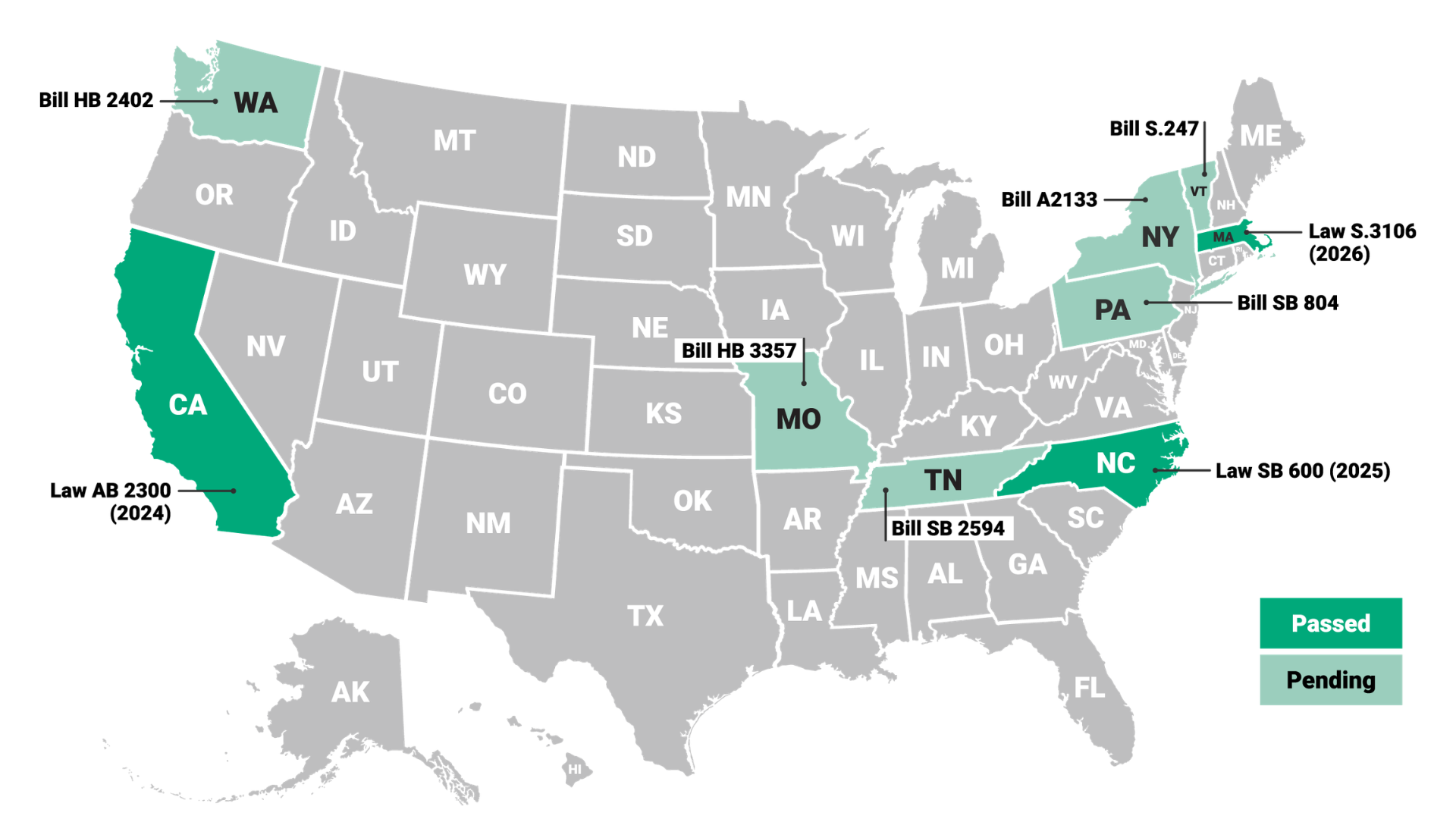
DEHP has been a growing concern for decades
Waiting until 2030 for non-DEHP infusion products is one option. Taking action now to protect patients is another.
2026
Toxic-Free Medical Devices Act
signed into Massachusetts law by Gov. Healey4
2025
Toxic-Free Medical Devices Act
signed into North Carolina law by Gov. Stein5
2024
Toxic-Free Medical Devices Act
signed into California law by Gov. Newsom6
2021
Congresswomen urge the FDA
to update guidelines on DEHP in medical devices7
2020
California enacts
Toxic-Free Cosmetics Act8
2012
Kaiser Permanente moves
to IV bags and tubing not made with DEHP9
2008
Federal ban of DEHP
in children’s toys10
2007
California bans DEHP
in children’s toys11
2006
American Medical Association
encourages hospitals to use alternatives to DEHP and PVC12
2003
California OEHHA
lists DEHP as Reproductive Toxicant13
2002
FDA issues public health notification
about DEHP and PVC14
1999
Healthcare Without Harm
launches campaign to remove DEHP from medical devices15
A long history of protecting patients and the planet
Forty years of doing the right thing

The only full line not made with DEHP or PVC
We’re committed to protecting the entire IV fluid pathway. And today, we’re the only medical supplier offering a full line of IV drugs, IV and nutrition solutions and irrigation containers—plus a robust line of IV sets and connectors—not made with DEHP or PVC.
In total, B. Braun offers over 600 non-DEHP products right now, allowing you to standardize across the IV fluid pathway from bag to patient, helping to reduce opportunities for exposure and limit avoidable risk.
Pioneers in patient safety
Patient safety has long been in our DNA. We were the first supplier to recognize the potential patient and environmental risks associated with toxic chemicals like DEHP more than four decades ago.
We’ve invested more than $1.2 billion to establish a manufacturing infrastructure to help health systems meet the demand for non-DEHP IV bags and tubing. And we encourage providers to switch to non-DEHP IV products before it’s mandated by law.


Protecting the most vulnerable patients
Critically ill pre-term infants in NICUs can receive up to 16 mg/kg/day of DEHP, which is 4k to 160k times higher than levels considered safe for avoiding reproductive and hepatic toxicities.16
Our products help eliminate the potential risk of DEHP exposure for all patients. And B. Braun is also the only company with TrophAmine® Amino Acids and Neonatal Starter Bags not made with DEHP or PVC—designed specifically for our most vulnerable patient populations.
The only Nurse Approved option available on the market today
Nurses are the front line of IV administration, handling countless infusions daily. The Nurse Approved certification is awarded based on the Nurse Quality Standard Index™ score after products are reviewed for usability, workflow integration and nursing practice needs. B. Braun IV Solutions and Plastic Irrigation Containers not made with DEHP or PVC are the only IV solution offerings on the market to be certified Nurse Approved.


Safe packaging design, assured savings
Designed to be recycled, our IV bags are made with polypropylene, a non-toxic material that is the third most recycled plastic in the United States. They also weigh less than IV bags made with DEHP or PVC. In fact, some B. Braun EXCEL® bags weigh roughly half as much as comparable alternatives, potentially saving a hospital using 300,000 1000 mL IV bags annually over $25,000 in waste disposal costs per year by switching to B. Braun’s EXCEL L8000 1000 mL IV bags.17
Making change easier with B. Braun Supply Assurance
You can count on B. Braun for your non-DEHP equipment—backed by bi-coastal, U.S.-based manufacturing, a first-of-its-kind Supply Assurance Program that guarantees 45 Days Inventory on Hand and operational support designed to simplify implementation.
All to help make it easier to bring our non-DEHP portfolio to your health system.

Choose non-DEHP IV products from B. Braun
When it comes to safety, the choice is clear.
Free whitepaper download
See how two IDNs switched to B. Braun IV products not made with DEHP.
Integrated delivery networks (IDNs) Legacy Health and Sharp HealthCare recently transitioned to B. Braun's non-DEHP IV solutions and shared their experiences regarding their reasons for the switch, the vendor selection process, implementing the transition and realizing the positive impacts.
*Asterisk indicates required field
Your request could not be submitted. Please try again.
warningNews and Media
-
WEBINAR: Protecting Patients from Hidden Harm: Hospitals Confront Toxic Chemicals in IV Therapy (The Journal of Healthcare Contracting).
link
-
LEGISLATION: North Carolina Senate Bill 600, also known as the Toxic-Free Medical Devices Act of 2025, bans IV bags and tubing made with DEHP
link
-
PARTNER NEWS: Sharp Healthcare touts B. Braun sustainability and savings benefits in their Earth Day article
link
-
LEGISLATION: California was the first state to ban the use of DEHP from IV bags and tubing used in the state with the Toxic-Free Medical Device Act (AB-2300)
link
*Non-DEHP = Not made with DEHP. There may be trace, non-intentional amounts of DEHP residue or by-product in the product (<1000 ppm or 0.1%bw).
*Non-PVC = Not made with PVC. There may be trace, non-intentional amounts of PVC residue or by-product in the product (<1000 ppm or 0.1%bw).
1. Hyman S, Acevedo J, Giannarelli C, et al. Phthalate exposure from plastics and cardiovascular disease: global estimates of attributable mortality and years life lost. EBioMedicine. 2025;117:105730. doi: 10.1016/j.ebiom.2025.105730
2. Hannas BR, Furr J, Lambright CS, et al. Dipentyl phthalate dosing during sexual differentiation disrupts fetal testis function and postnatal development of the male Sprague-Dawley rat with greater relative potency than other phthalates. Toxicol Sci. 2011:120(1):184-193.
3. Darbre PD. Chemical components of plastics as endocrine disruptors: overview and commentary. Birth Defects Res. 2020;112(17):1300-1307. doi: 10.1002/bdr2.1778
4. Massachusetts. An Act relative to toxic-free medical devices. S.3106, 194th General Court (2026). Accessed September 1, 2026. https://malegislature.gov/Bills/194/S3106
5. North Carolina. Toxic-Free Medical Devices Act of 2025. S600, General Assembly. Accessed September 1, 2026. https://www.ncleg.gov/BillLookUp/2025/S600
6. California. ToxicFree Medical Devices Act. AB2300, Chapter 562 (2024). Accessed September 1, 2026. https://leginfo.legislature.ca.gov/faces/billTextClient.xhtml?bill_id=202320240AB2300
7. Porter K, et al. Letter to the FDA. February 18, 2021. Accessed March 24, 2025. https://roar-assets-auto.rbl.ms/documents/8190/Letter%20to%20FDA%20about%20DEHP%20IV%20Bags.pdf
8. California first state to ban 24 toxic chemicals in personal care products and cosmetics. Breast Cancer Prevention Partners press release. September 30, 2020. Accessed September 1, 2026. https://www.bcpp.org/california-first-state-to-ban-24-toxic-chemicals-in-personal-care-products-and-cosmetics/
9. Guevarra L. Kaiser gets green infusion with safer IV equipment. Trellis. Accessed September 1, 2026. https://trellis.net/article/kaiser-gets-green-infusion-safer-iv-equipment/
10. CPSC prohibits certain phthalates in children's toys and child care products. United States Consumer Product Safety Commission. October 20, 2017. Accessed March 24, 2025. https://www.cpsc.gov/s3fs-public/cpsia.pdf
11. Proposition 65 Warnings. Di(2-Ethylhexyl)Phthalate (DEHP). Official website of the State of California. 2021. Accessed April 1, 2025. https://www.p65warnings.ca.gov/fact-sheets/phthalates
12. American Medical Association. Encouraging alternatives to PVC/phthalate products in health. H-135.945. AMA Policy Finder. Accessed April 1, 2025. https://policysearch.ama-assn.org/policyfinder/detail/pvc?uri=%2FAMADoc%2FHOD.xml-0-316.xml
13. California Office of Environmental Health Hazard Assessment. Accessed March 24, 2025. https://oehha.ca.gov/proposition-65/chemicals/di2-ethylhexylphthalate-dehp
14. Schettler T. Polyvinyl chloride in health care: a rationale for choosing alternatives. Health Care Without Harm. January 2020. Accessed April 1, 2025. https://us.noharm.org/media/4423/download?inline=1
15. Brown D. Campaign seeks to eliminate plastic IV bags, but risk is disputed. The Washington Post. July 21, 1999. Accessed March 24, 2025. https://www.washingtonpost.com/archive/politics/1999/02/22/campaign-seeks-to-eliminate-plastic-iv-bags-but-risk-is-disputed/4b366a86-5b5f-4cc7-b4ab-b0394c4d3e63/
16. Mallow EB, Fox MA. Phthalates and critically ill neonates: device-related exposures and non-endocrine toxic risks. J Perinatol. 2014;34(12):892-897. doi:10.1038/jp.2014.157
17. B. Braun Data on File - Waste Savings Calculation